Nov. 27, 1966: Roughriders welcomed home after landmark Grey Cup win
 Rob Vanstone
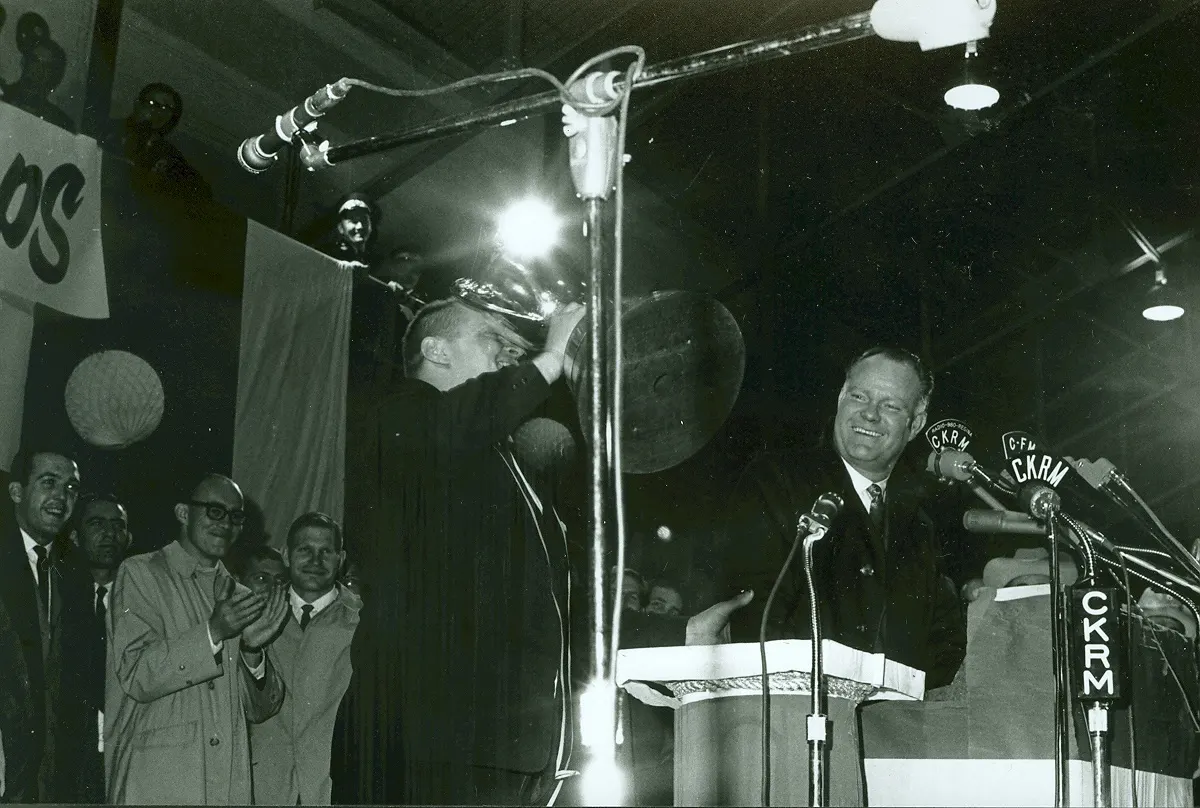
Photo courtesy Regina Leader-Post
Roughriders offensive lineman Reg Whitehouse raises the Grey Cup at the Regina Armoury on Nov. 27, 1966 — 60 years ago today — as Head Coach Eagle Keys looks on. Photo courtesy Regina Leader-Post.
Suddenly, 60 years ago feels like yesterday.
Mike O’Donnell enters the Regina Armoury’s expansive Drill Hall and vivid, cherished memories of Nov. 27, 1966 come flooding back.
One day earlier, the Saskatchewan Roughriders had won the first Grey Cup championship in franchise history — defeating Ottawa 29-14 on a Saturday afternoon at Empire Stadium in Vancouver.
On the Sunday — 60 years ago today — the newly crowned CFL champions flew back to Saskatchewan. Upon landing at the Regina airport, the team boarded buses and were transported to the Armoury for a public celebration that, until then, was without precedent.
“That whole sense of just being together — of people being pressed in together — was kind of new to a 15-year-old kid,” says O’Donnell, who attended the event with his father, Wilf.
“There was a common purpose of why everyone was here, so it was a happy place.”
Being interviewed for this retrospective, O’Donnell is seated three or four first downs away from the south end of the Drill Hall.
“There was an elevated stage and the players were just packed on there,” he remembers. “The stage wasn’t very big.
“I can walk you over to the corner and show you where (future Canadian Football Hall of Fame inductee) Ron Atchison stood, because he was a local guy and a good guy. He mattered to me. That’s what I think of when I come in here.
“He was one of the players who got to speak. The coach, Eagle Keys, was there. So was the general manager, Ken Preston. That was the program.
“It wasn’t glamorous or elaborate. It was just, ‘Here’s the guys who won.’ As a community, we were just so happy that little Regina, little Saskatchewan, had accomplished something like this. That was more the feeling.
“There was a sense of community pride that I had never felt before.”
Thirteen years before Rider Pride became a saying, it was nonetheless evident at the Armoury — a building that will be 100 years old in 2027. Fittingly, the Armoury is just across the street from the Roughriders’ home at Mosaic Stadium.
“Once the game was finished and we had heard that there was going to be a gathering at the Armoury, my father turned to me and said, ‘We’re going to go,’ ” says O’Donnell, an accomplished educator who subsequently served for 14 years on Regina City Council.
“What was special for me is that’s not something my dad and I ever did. We didn’t do lots of things together, because he worked all the time. For him to make a point that he and I were going to go was really cool. Being in the building for the first time was part of that.
“As I look back, if it wasn’t Exhibition Stadium, this was the only alternative. There weren’t a lot of places in Regina in ’66 where you could gather people.
“So, somehow or other, we got into the building and we made our way to the very edge of the stage. I was very close to where all the Riders came in.
“There was a doorway where they were allowed to get in without having to cut through the crowd. The place was full. The players were shoulder to shoulder.
“When the microphone was turned on, they started to speak.”
But not before receiving a three-minute standing ovation. Keys proceeded to introduce each player. The victorious quarterback, Ron Lancaster, was the first to address the crowd on a Sunday evening.
“The only thing I can tell you is what you said all year: We had them all the way,” joked Lancaster, alluding to the fact that Saskatchewan was regarded as the decided underdog leading up to the all-the-marbles matchup with the eastern Riders.
Lancaster was followed at the microphone by Atchison and fellow teammates George Reed, Hugh Campbell and Ed Buchanan.
“Ever since I’ve been here, we’ve had great fans,’’ Atchison said from the stage. “This year we had a great team.”
The culmination of the gathering took place when Reg Whitehouse — like Atchison, a Roughrider since 1952 — held the Grey Cup over his head.
“This is the greatest moment of my life,” the venerable offensive lineman told an appreciative audience. “All I want to do now is get home to sleep, because I’ve been partying it up pretty good all night.”
The Roughriders were joined on-stage by an assortment of dignitaries, including Premier Ross Thatcher, Regina Mayor Henry Baker and Lt.-Gov. Robert Leith (Dinny) Hanbidge.
Hanbidge, then 75, had a special connection to the team. He played for the Regina Rugby Club — forerunner to the Roughriders — during its first four seasons (1910 to 1913).
When the team finally won a Grey Cup, after eight previous appearances in the national final, Hanbidge was in Vancouver for the game. He was also on the team’s flight back to Regina.
As the Roughriders prepared for a triumphant return home, residents of Regina were encouraged to turn on their Christmas lights in recognition of the players and coaches who would see the predominantly green and white bulbs from the aircraft.
“We had that fantastic reception by the city,” Hugh Campbell reflected 40 years after making the game-winning touchdown catch in the 54th Grey Cup Game. “That was one of the most fantastic moments of my sporting life.
“When we got to the airport, it was just quiet. It was nighttime and there wasn’t anybody there to greet us, which I thought was a little weird. I thought, ‘Maybe they’re all still in B.C., drinking or something.’
“As we left the airport, people were lined in the streets in front of all the houses and we weaved through a pre-designated path. There were people on their front lawns with signs. It was just the most fantastic greeting.”
People had begun assembling in the 10,000-square-foot Drill Hall at 6:30 p.m., three hours before the team entered the premises.
According to the Regina Leader-Post, at least six people fainted from the heat. St. John Ambulance treated 12 other individuals who, as reported by the newspaper, “were just plain weak from the crush or sick to the stomach.”
It was, after all, long past suppertime when the returning champions were introduced and saluted.
“When it ended and the players started to file out, people didn’t know what to do,” O’Donnell says. “It was like, ‘Now what?’ You didn’t want to leave, but the players were tired. They had to go.
“There were a lot of people turning to one another and saying something and smiling. Maybe there was a handshake, because it was 1966.
“It was respectful, it was calm, and it was a nice time to be together.”
ROBSERVATIONS: Defying Father Time — just like old times … Meyers’ major! … seeing stars
Robservations
ROBSERVATIONS: How has it been one year? … flag football flashback! … and the weekly wanderings
Robservations
ROBSERVATIONS: Milestone monitor … touting the talents of Trevor, Tommy and teammates … and Rob’s random ramblings
Robservations
ROBSERVATIONS: Hit the ground running … 1981 Halloween horror! … Roughriders-Lions playoff history
Robservations