
Honouring former Roughrider "Ripper" Ray on Remembrance Day
 Rob Vanstone
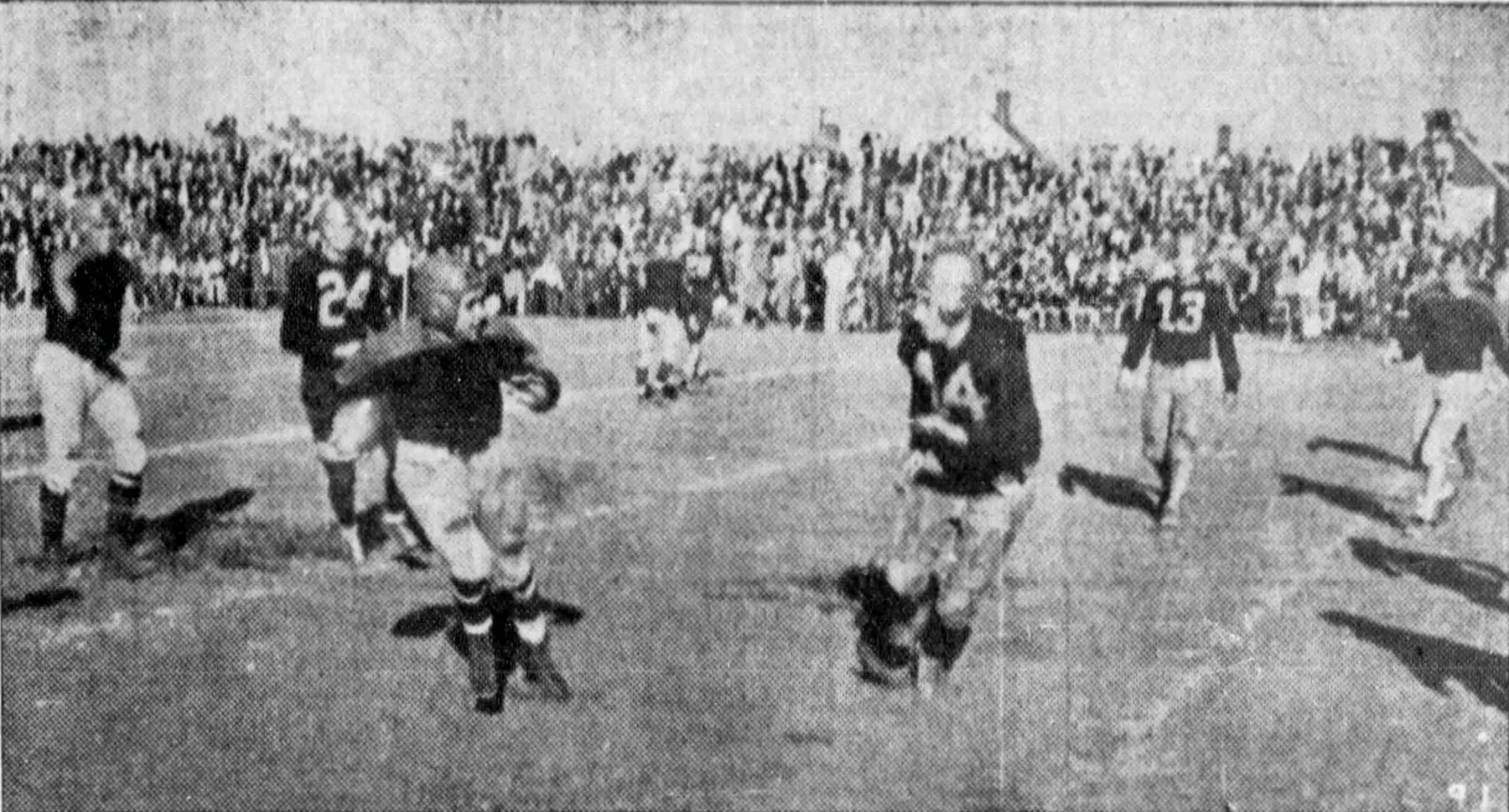
Photo courtesy Regina Leader-Post
Fred (Ripper) Ray of the Regina Roughriders returns an interception while being pursued by Lou Mogul (14) of the Winnipeg Blue Bombers at Park de Young on Sept. 12, 1936. (Photo courtesy Regina Leader-Post.)
Fred Ray’s position with the Roughriders — flying wing — perfectly captured his passions.
Ray, who grew up in South Dakota, excelled on the gridiron with the Regina-based Western Interprovincial Football Union side in 1936 and 1937.
Determined to fly and to fight for the forces of freedom, Ray eventually joined the Royal Canadian Air Force with the ambition of serving in the Second World War.
Tragically, he would not attain that goal.
Ray was only 25 when he lost his life in a flight-training accident near Prince Albert on July 1, 1941. The United States did not enter the War until Dec. 7 of that year, following the surprise attack on Pearl Harbor.
“With the majority of Americans, Ray sincerely believed that Britain’s fight is our fight, that her triumph over Hitler is necessary for the preservation of freedom and liberty on this side of the ocean,” read a portion of a Rapid City Journal editorial that was published on July 3, 1941. “So intense was his belief that he volunteered his services to Britain.
“Ray gave his life for that cause as truly as if he had died in sky battle. Nor have his services been in vain.
“For the past three months he had served as an instructor with the Royal Canadian Air Force, and the skill he imparted to his pupils will be reflected in the aerial warfare between Britain and Germany. The guns of those valiant British and Canadian sky-fighters will speak for Fred.”
Frederick Byron Ray Jr. was born in Yankton, S.D., on March 22, 1916, during the First World War. His father, Major Fred B. Ray, served in that conflict after having fought in 1898 during the Spanish-American War.
After starring for the University of South Dakota Coyotes, Fred Jr. joined the Regina Roughriders in 1936 and wasted little time making a positive impression.
In his WIFU debut, he intercepted a “forward pass” — a relatively new strategy at the time — to help the Roughriders edge the visiting Winnipeg Blue Bombers 8-7 on Sept. 12, 1936.
A week later, “Ripper” Ray ran for touchdowns of two or four yards to power the host Roughriders to an 18-2 victory over the Calgary Bronks.
He finished the 1936 campaign with four majors in six regular-season games, earning All-Western flying wing honours on a dream team selected by Maclean’s magazine.
Ray returned to the Roughriders in 1937 but was limited to three games by an injury.
He then returned home to South Dakota and attended the School of Mines, based in Rapid City. In 1938, he helped the school’s football team (the Hardrockers) win the South Dakota Intercollegiate Conference title.
Ray had hoped to join the United States Army Air Corps, “but was rejected because he was overweight,” the Rapid City Journal reported.
“The youth’s determination to ‘fly for somebody’ led him to purchase his own plane and take a course of training,” the Rapid City newspaper added. “On completing it, he immediately left for Regina to enlist with the RCAF.”
Ray joined the Roughriders for several practices in 1940, with the hope of balancing football with his RCAF obligations.
“When his superior officers reluctantly decided that members of the RCAF could not play football, Ray promptly laid aside his moleskins and helmet,” the Leader-Post reported on Aug. 21, 1940.
Interviewed by the newspaper, Ray said: “I’d like to play football, but flying comes first. All I want is one crack at Hitler’s planes. Boy, one fight in the air will be worth a dozen football games.”
Ray had begun flight training on June 18, 1940, nearly a year before the fatal crash at the RCAF No. 4 Flying School. A 20-year-old student pilot, Jack Kugelmass of Montreal, also perished in the accident.
The tragedy occurred shortly before Ray was to be married during a two-week break in South Dakota
Ray was buried in Rapid City with full military rites. The Canadian and American flags were on display during the funeral service.
Per the American Legion funeral protocol, Ray’s mother was presented with a Canadian flag.
At the service, Turner M. Rudesill of the American Legion read a letter from G.L. Gray, president of the Canadian Legion’s Regina branch.
“We have felt for some years that Freddie was one of our boys,” Gray wrote, “and his coming to us in our hour of need, the first American to go through the Regina recruiting station for the Flying Corps, doubly endeared him to his many friends and admirers.”
ACKNOWLEDGMENTS: Regina Leader-Post (Sports Editor: Taylor Shire), Rapid City Journal.